

Have you ever wondered why your handheld UHF radio’s range sometimes falls short of expectations, or how you can reliably extend it? For users of civilian handheld UHF (Ultra High Frequency) radios, understanding the interplay between output power, antenna length, environment, and communication distance is crucial. This guide breaks down these technical relationships into actionable insights, helping you predict performance and implement solutions like repeaters to break through range barriers.
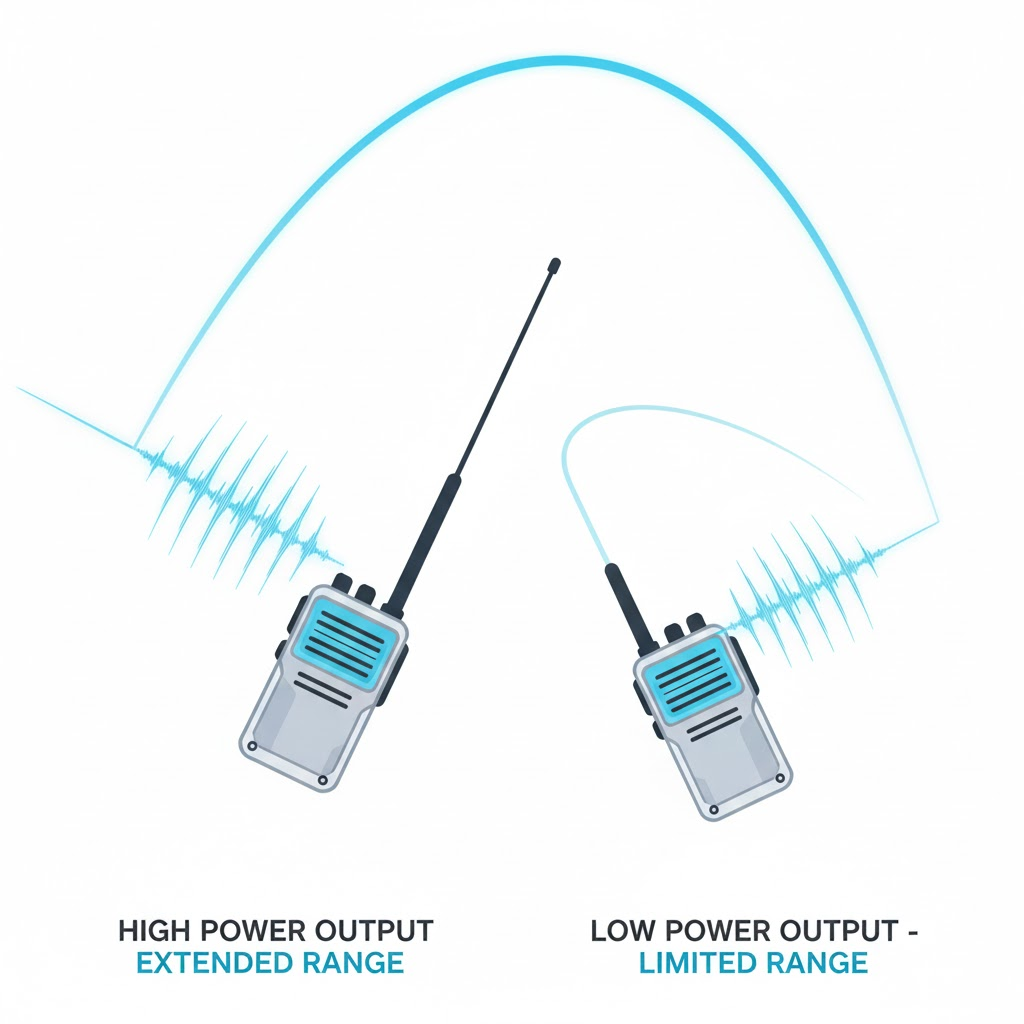
Core Factor 1: Output Power (Watts) – The Engine of Your Signal
Output power, measured in watts (W), is the transmitter’s driving force. Common handheld UHF radios range from 0.5W (Low Power) to 5W or 6W (High Power).
- The Direct Relationship: Generally, higher wattage means a stronger signal can travel farther before fading into background noise. Doubling the power (e.g., from 1W to 2W) does not double the range but provides a meaningful boost in signal strength, helping it penetrate minor obstructions.
- The Law of Diminishing Returns: Increasing power has physical and practical limits. A jump from 1W to 5W offers a significant gain, but going from 5W to 10W yields a smaller relative improvement while drastically increasing battery drain. For handhelds, 4-5W is often the optimal balance of power and portability.
Core Factor 2: Antenna Length & Gain – The Signal’s Precision Lens
If power is the engine, the antenna is the steering wheel and amplifier. For UHF frequencies (typically 400-470 MHz), there is a direct link between physical antenna length and efficiency.
- The Quarter-Wave Principle: The most basic and efficient antenna length for a given frequency is a quarter of its wavelength. For UHF at ~460 MHz, this calculates to roughly 6 inches or 15-16 cm. Many stock “rubber duck” antennas approach this length, offering a good omnidirectional radiation pattern.
- Antenna Gain (dBi): Gain measures how effectively an antenna focuses radio energy. A higher-gain antenna (e.g., 3 dBi vs. 0 dBi) concentrates the signal into a tighter, flatter, “pancake-like” pattern. This extends usable range in horizontal directions (like across flat terrain) but can create poor coverage directly above or below the radio. Longer antennas often have higher gain.
- Practical Tip: Replacing a short, stock antenna with a longer, tuned aftermarket whip can be the single most effective upgrade for improving handheld range without increasing battery consumption.
The Decisive Factor: Operational Environment
Environment often outweighs both power and antenna. UHF signals travel primarily by line-of-sight and are good at penetrating man-made structures but are easily blocked by solid, dense materials.
- Open, Flat Terrain (Ideal): Over water or flat ground with clear line-of-sight, a 5W UHF radio with a standard antenna can achieve 3-8 km (2-5 miles). Signal degradation is gradual.
- Urban/Suburban Areas (Challenging): Buildings absorb and reflect signals. Range becomes highly unpredictable, often reduced to 1-3 km (0.6-2 miles), relying on signal reflections (“multipath”).
- Dense Urban/Indoor/Heavy Foliage (Most Limiting): Concrete walls, metal structures, and densely wooded areas severely attenuate signals. Communication may be limited to less than 1 km, sometimes only to different floors or rooms within the same building.
Relationship Summary Table
| Factor | Role & Ideal Spec | Impact on UHF Range | Practical Consideration |
|---|---|---|---|
| Output Power | Signal strength source. 4-5W is handheld sweet spot. | Strong positive correlation, but with diminishing returns. | Higher power drains batteries faster. Balance is key. |
| Antenna Length | Signal coupler & focus. ~16cm (1/4 wave) for UHF. | Critical. A better antenna improves both transmit & receive. | Longer, gain-optimized antennas drastically outperform short stocks. |
| Environment | Signal pathway. Clear line-of-sight is ideal. | Overwhelming factor. Can reduce theoretical range by 90%+. | Always the primary variable for range estimation. |
The Ultimate Range Extender: The UHF Repeater System
When power, antenna, and height are insufficient, a repeater system is the professional solution.
A repeater is a fixed station consisting of a highly sensitive receiver, a high-power transmitter, and a large external antenna mounted at an elevated location (like a hilltop or tower). It works like a “signal bridge”:
- Your handheld (on a designated input frequency) sends a weak signal to the repeater.
- The repeater receives it, amplifies it powerfully, and retransmits it (on an output frequency) over a wide area.
- Other handhelds within this much larger area receive the strong, repeated signal.
- Range Transformation: A repeater can extend the effective communication range of 5W handhelds from a few kilometers to over 50 km, covering an entire city or region. It overcomes local terrain obstacles by leveraging its superior height and power.
- Practical Application: Repeaters are essential for public safety, event security, ski resorts, and large industrial facilities. For civilian users, some communities or hobby groups set up shared repeaters. Dual-band handhelds (UHF/VHF) with repeater offset capability are required to access these systems.
Conclusion & Final Recommendations
Maximizing your UHF handheld radio’s range is a systematic process:
- Start with the Antenna: Before seeking more power, upgrade to a higher-gain, full-length antenna. This improves both transmission and reception.
- Use Power Wisely: Operate on High Power (5W/6W) when range is critical, but switch to Low Power for close-quarters to save battery.
- Master Your Environment: Elevate your position. Moving to a window, hilltop, or clearing can have a more dramatic effect than any equipment change.
- Plan for Infrastructure: If consistent wide-area coverage is needed, investigate or establish a repeater system. It is the only way to guarantee reliable communication across challenging, large-scale environments.
By understanding and optimizing these four interconnected elements—power, antenna, environment, and repeater use—you can fully harness the capability of your UHF handheld radio, ensuring clear communication exactly when and where you need it most.